Article 68 of the Transitional Constitutional Provisions Act (ADCT) recognized the right to collective ownership of quilombola territories and established the constitutional protection of quilombola communities in Brazil.






 In 1988, the National Constituent Assembly approved Article 68 of the Transitory Constitutional Provisions Act (ADCT) of the Federal Constitution. A victory for quilombola communities, the provision recognized their right to definitive ownership of their territories, mandating that the State issue the corresponding land titles.
Read also
The first land title granted to a quilombola community in Brazil turns 30 years old.
The article states: "The remaining members of the quilombo communities who are occupying their lands are recognized as having definitive ownership, and the State must issue them the respective titles."
It was the Unified Black Movement (MNU) that, through Suggestion No. 2.886, formally submitted to the Constituent Assembly the popular proposal to guarantee access to land for quilombola communities. It intended to include a specific chapter in the Constitution entitled "On Black People".
The proposal did not reach the minimum number of signatures, and Benedita da Silva (PT-RJ), a member of the Constituent Assembly and the only black woman to be part of the Assembly, formally presented the text.
Later, another popular amendment was presented by the Center for Afro-Brazilian Studies (DF), the Zumbi Cultural Association (AL), and the José Patrocínio Association (MG). This proposal also did not receive the minimum number of signatures, and therefore was resubmitted by Deputy Carlos Alberto Caó (PDT-RJ).
In the middle of the legislative process, the proposal presented by the Black movement was divided into two parts: the one concerning the preservation of quilombos (settlements of escaped slaves) remained in §5 of Article 216, and the other part, concerning lands, went to Article 68 of the ADCT (Transitional Constitutional Provisions Act).
During the Constituent Assembly discussions, the rights of quilombola communities, as well as the rights of indigenous peoples, were initially included in the transitional provisions of Section I, Chapter III, entitled "On Blacks, Minorities, and Indigenous Populations."
As the trajectory of Article 68 demonstrates, what was imposed as a temporary measure has become a permanent landmark in the struggle for territorial rights and the recognition of quilombola communities in Brazil.
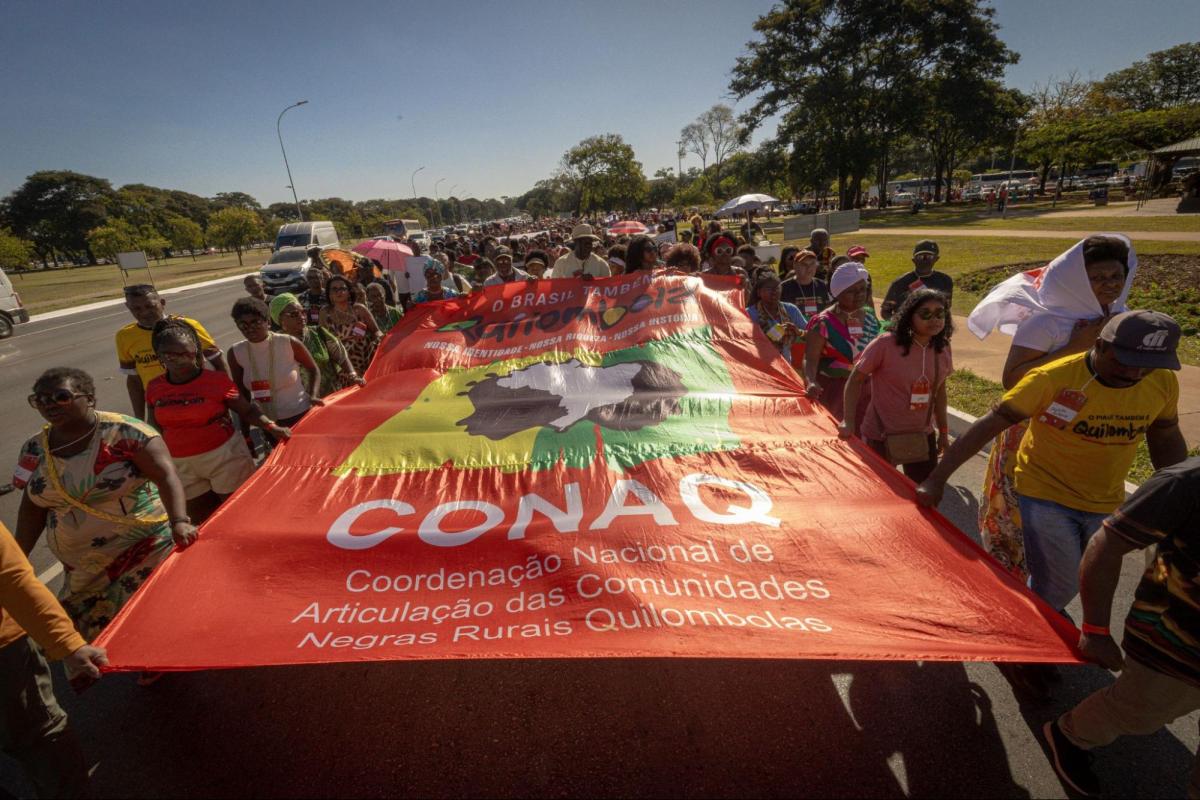
In 1995, the Quilombo de Boa Vista, in Oriximiná (PA), received the first collective land title after the 1988 Constitution. Since then, the struggle for land titling has been marked by the demand for these rights in the face of various challenges, such as delays in land regularization, conflicts, and the advance of economic activities, such as mining, which put pressure on traditional territories.
Read also
Interactive map reveals previously unpublished data on quilombola territories in the Amazon.
The definitive titling of a quilombo territory occurs when the State delivers to the community a document that allows the transfer of ownership of the entire area to the quilombo's representative association. But since the promulgation of the Constitution in 1988, and even before the titling, quilombos have had rights over their territories.
This process for granting land titles begins with (1) the community self-definition as a quilombola community and (2) the issuance of a certification by the Palmares Cultural Foundation. Then, (3) the National Institute for Colonization and Agrarian Reform (Incra), or state land agencies, conduct historical, anthropological, land tenure, and environmental studies to identify and delimit the territory. After (4) stages of analysis, contestation, and expropriation of private areas, when necessary, the territory can be (5) officially titled in the name of the community's representative association, enabling greater guarantees for collective land ownership and the protection of their ways of life, cultural practices, and traditional forms of organization.
Learn more about the certification path here.
Quilombos: Ancestry, Territory, and Socio-environmental Conservation
According to Decree No. 4.887/2003, which governs the regularization of these areas, quilombos are formed by "ethnic-racial groups, according to self-attribution criteria, with their own historical trajectory, possessing specific territorial relations, with a presumption of black ancestry related to resistance against historical oppression suffered."

Like Conservation Units and Indigenous Lands, Quilombola Territories are also considered "protected areas" by the National Strategic Plan for Protected Areas (PNAP, Decree No. 5.758/2006).
Quilombola Territories are recognized as collective properties of the communities, titled in the name of the Quilombola associations, guaranteeing the permanence of the ways of life, cultural practices, and historical relationship of these populations with the land.
For this reason, the land cannot be sold, divided, or treated as individual property, because it belongs collectively to the community. This means that the territory is inalienable: it exists to guarantee the continuity of life, culture, memory, and way of life.
According to the study "Forests Need People," published in 2022, protected areas occupied by indigenous peoples, quilombola communities, and other traditional communities show higher rates of preserved and regenerating native vegetation. Conversely, Conservation Units with fewer usage restrictions, such as Environmental Protection Areas (APAs) and their buffer zones, register greater deforestation and more intense cycles of environmental degradation.
The data reinforces the idea that traditional land occupation and management methods act as important barriers to deforestation, contributing to the protection of biodiversity and the regeneration of ecosystems. The study also highlights the importance of strengthening public policies for territorial protection and environmental recovery in the most pressured areas.
The effective implementation of the right to territorial recognition is therefore fundamental to guaranteeing the protection of biodiversity.
Throughout the struggle for the recognition of collective territories, the fight for environmental conservation and the defense of traditional ways of life has also been consolidated. Quilombola territories, Indigenous lands, and extractive reserves demonstrate that traditional peoples and communities have historically acted as guardians of forests and biodiversity.
It is worth remembering that there are many Quilombola Territories that are not titled or whose titling process is hampered by various legal issues. According to the 2022 IBGE census , the Quilombola population is 1.330.186 people and there are 7.666 identified Quilombola communities in all regions of Brazil. Only the states of Acre and Roraima do not have Quilombos.
Since 1988, only 25 quilombos have been fully titled, in addition to open processes at INCRA awaiting titling. Therefore, quilombola communities continue to resist and fight for the guarantee of their territories, affirming ways of life that contribute directly to environmental conservation and the protection of biodiversity.
Read also
“Our territory is within us and we are within it!”
This is what we work on in the Educational Kit: Forest with people inside: the struggle for traditional and collective territories and for environmental conservation . By defending their territorial rights, the quilombola communities also protect forests, which are fundamental for climate balance and for the collective well-being of the entire society.
Learn more about the initiatives and productions of CONAQ's education collective.
In 2026, the National Coordination of Rural Quilombola Black Communities (Conaq) will celebrate its 30th anniversary. To mark the date, between June 10th and 14th, Brasília will host the III National Meeting of Quilombola Women, with the central motto "Quilombola Women in defense of climate justice, reparation and democracy: we are the beginning, the middle and the beginning!". The meeting is expected to bring together more than 500 women from 24 states, as well as some international representatives.
Read also
Meeting of quilombola women expected to bring together more than 500 leaders in Brasília.
30 years of CONAQ: session in the Chamber honors the largest quilombola organization in Brazil.
Educators, come and discover the teaching kit that brings together sources and documents with suggestions for reflection to support discussions and activities on the subject in the classroom!
Read also
Educational Kit: Traditional Knowledge and Sustainable Income Generation Strategies: Proposals from Indigenous Peoples and Traditional Communities
Educational Kit: The role of traditional communities in preserving the biodiversity of the Volta Grande do Xingu region.
References
AMAZON QUILOMBOLA. Amazon Quilombola Panel . Brazil, 2025. Available at: https://amazoniaquilombola.org.br/ . Accessed on: May 25, 2026.
BARROS, Luiza de Souza; SANTOS, Tiago Moreira dos (org.). Deforestation in Indigenous Lands: Caatinga, Atlantic Forest, Pampa and Pantanal . São Paulo: Instituto Socioambiental, 2025. Available at: https://acervo.socioambiental.org/acervo/documentos/desmatamento-em-terras-indigenas-caatinga-mata-atlantica-pampa-e-pantanal . Accessed on: May 25, 2026.
BRAZIL. Constitution (1988). Constitution of the Federative Republic of Brazil of 1988. Act of Transitory Constitutional Provisions, art. 68. Brasília, DF: Presidency of the Republic, 1988. Available at: https://www.planalto.gov.br/ccivil_03/constituicao/constituicao.htm . Accessed on: May 25, 2026.
DIAS, Luiz Marcos de França et al. In the company of Dona Fartura: a story about Quilombola food culture. Illustrations by Amanda Nainá dos Santos and Vanderlei Ribeiro. 1st ed. São Paulo: Instituto Socioambiental (ISA), 2022. Available at: https://acervo.socioambiental.org/sites/default/files/publications/03l00037.pdf . Accessed on: May 25, 2026.
INCRA. Title of recognition of ownership no. 01/95: title of recognition of ownership that the Federal Union and INCRA grant to the Association of the Remaining Quilombo Community of Boa Vista. Brasília, DF: INCRA , 1995. Available at: https://acervo.socioambiental.org/acervo/documentos/titulo-de-reconhecimento-de-dominio-n-0195-titulo-de-reconhecimento-de-dominio . Accessed on: May 25, 2026.
OVIEDO, Antonio Francisco Perrone; DOBLAS, Juan. Forests need people. São Paulo: Instituto Socioambiental, 2022. Available at: https://acervo.socioambiental.org/acervo/documentos/florestas-precisam-das-pessoas . Accessed on: May 25, 2026.
**The Today in Socio-Environmental History series presents the wealth of information from the Socio-Environmental Institute's collection , which has more than 250 cataloged items focused on socio-environmental themes, such as publications, books, theses and dissertations, maps, news, audiovisual materials, among others. Today in Socio-Environmental History is an invitation to reread Brazil with greater breadth, sensitivity, and justice, valuing the memory and documentation of its diverse peoples.**
This publication is supported by the Amazon Fund and is a product of the project "Defense and Promotion of Indigenous Rights in Brazil: Building Capacities and Engaging People for a More Just Future," carried out by the Socio-Environmental Institute (ISA), with funding from the European Union.
The content of this material is the sole responsibility of the institution that produced it and does not reflect the position of the European Union.


 Loading